

Security of Payment (SOP) laws operate in every Australian state and territory. They give people who do construction work, or supply related goods and services, a fast way to recover money they are owed without going to court, through a process called adjudication.
If you do construction work under a contract and you don't get paid, these laws are usually the quickest and cheapest tool you have.
Does SOP apply to fridgies, sparkies and other tradies?
Usually, yes — for commercial and construction work, and often for residential work too. SOP covers 'construction work' and related goods and services, which takes in installing, maintaining, repairing and testing air conditioning, refrigeration, electrical, plumbing and other building services.
The common myth is that SOP doesn't apply to residential work. The real test is who you contract with. Most SOP Acts only exclude contracts where the other party is a home owner who lives, or intends to live, in the property (an owner-occupier). If you work as a subcontractor to a builder on a house or unit block, your contract is with the builder, not the home owner, so you are generally covered even though the site is residential. Don't assume residential work is out of scope before checking who is on the other side of your contract.
Which law applies in each state?
The state where the work is physically carried out decides which SOP law applies, not where your business is registered or where you signed the contract. The relevant states are:
New South Wales - Building and Construction Industry Security of Payment Act 1999 (NSW)
Victoria - Building and Construction Industry Security of Payment Act 2002 (VIC)
Queensland - Building Industry Fairness (Security of Payment) Act 2017 (QLD)
Western Australia - Building and Construction Industry (Security of Payment) Act 2021 (WA)
South Australia - Building and Construction Industry Security of Payment Act 2009 (SA)
Tasmania - Building and Construction Industry Security of Payment Act 2009 (TAS)
Australian Capital Territory - Building and Construction Industry (Security of Payment) Act 2009 (ACT)
Northern Territory - Construction Contracts (Security of Payments) Act 2004 (NT)
How long clients can take to pay
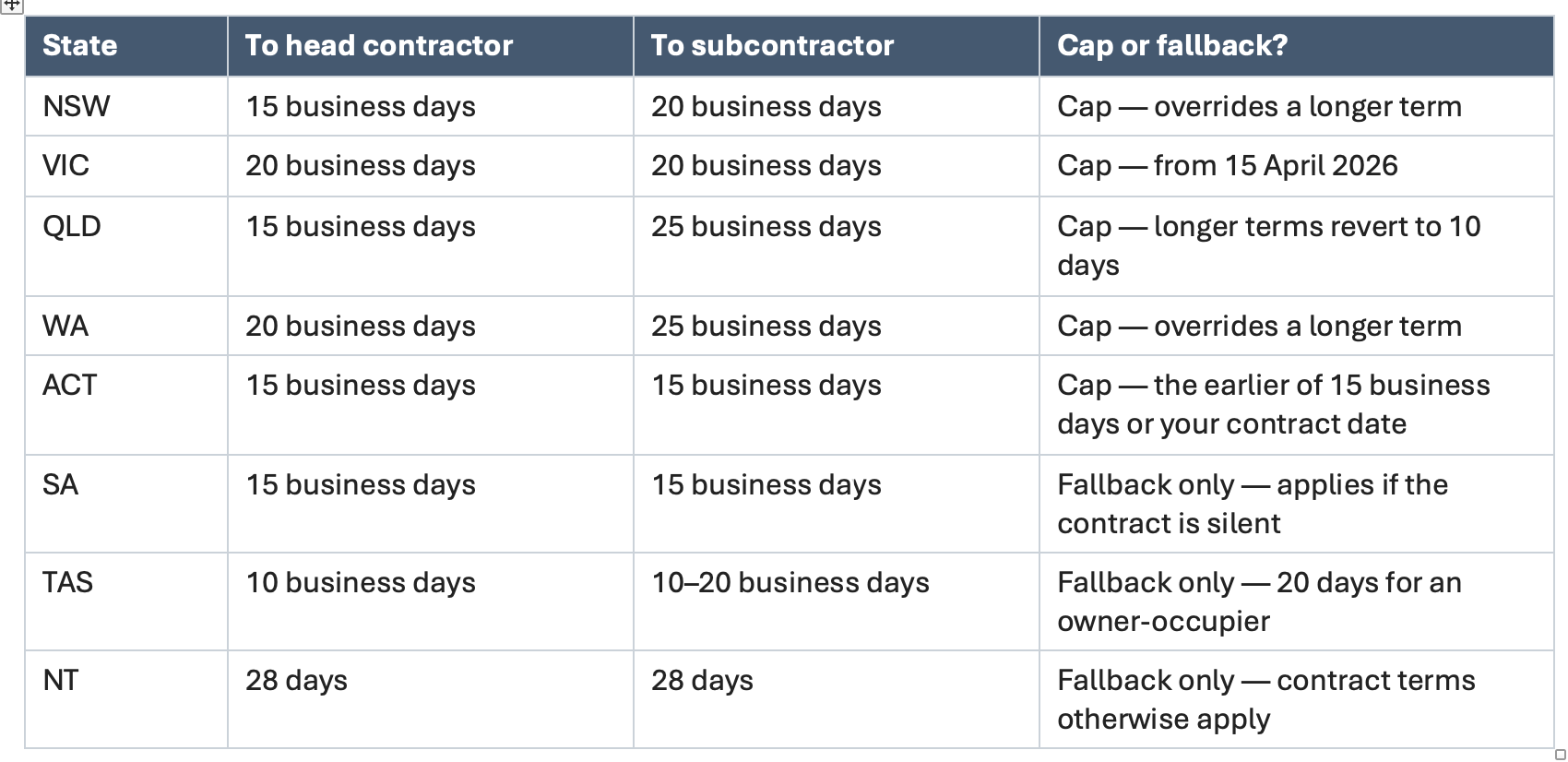
Some states cap how long a client can take to pay you. Others only set a fallback period that applies if your contract doesn't say anything. Knowing the difference matters: a cap overrides a longer term in your contract, a fallback doesn't.
These figures are for commercial construction work and run from the date your payment claim (invoice) is served.
What this means for your terms and conditions
When you set payment terms in your own terms and conditions , keep them within the cap for the states that have a cap.
If your contract says 30 days but the cap is 15 business days, the cap wins.
In SA, TAS and NT there is no cap, so the period you put in your contract is what governs the terms. In this case, set a term that works for you and that complies with any consumer rules for residential jobs.
Victoria (new laws)
Victoria made its biggest SOP changes in more than 20 years. They commenced on 15 April 2026 and apply to existing construction contracts, not only new ones signed after that date.
Here is a summary of the key points:
20 business day cap - clients can't take longer than 20 business days to pay, even if the contract says otherwise.
Reference dates abolished - you no longer have to wait for a monthly 'reference date'. You can claim for any construction work and associated costs under the contract.
Broader claims - contested variations, delay costs and time-related costs can now go to adjudication ( they were excluded before).
Performance security - you can use SOP to have bonds, guarantees and retention money released.
Longer claim window - you now generally have six months after practical completion of the construction work, or the supply of related goods and services, to make a payment claim, up from three months.
Holiday pause - SOP timeframes pause between 22 December and 10 January inclusive each year.
Unfair time bars - a court can declare a notice-based time-bar clause unfair and of no effect.
No new reasons later - if a client leaves a reason for not paying out of their payment schedule, they can't raise it for the first time in adjudication.
If you do commercial or construction work in Victoria, review your payment terms so they don't exceed 20 business days. The changes apply to jobs already underway, not just new ones.
What your invoice / payment claim must include
To use the SOP process, your invoice has to qualify as a valid payment claim under the relevant state law. This means that every invoice in ever state must include:
• Your business name and ABN
• Your client's name and address
• A description of the work or goods and services supplied
• The amount claimed, and how GST is treated
• The date the invoice was issued
• Your bank account details for payment
The SOP statement
Several states require your invoice to carry a specific line identifying it as a payment claim under their Act. Queensland, Victoria and the NT do not require that statement, so the wording is optional there.
Here is a state by state breakdown of what you need to include:
New South Wales - This is a payment claim made under the Building and Construction Industry Security of Payment Act 1999 (NSW)
Queensland (optional) - No statement required. The invoice just needs to identify the work and request payment.
Western Australia - This is a payment claim made under the Building and Construction Industry (Security of Payment) Act 2021 (WA)
South Australia - This is a payment claim made under the Building and Construction Industry Security of Payment Act 2009 (SA)
Tasmania - This is a payment claim made under the Building and Construction Industry Security of Payment Act 2009 (TAS)
Australian Capital Territory - This is a payment claim made under the Building and Construction Industry (Security of Payment) Act 2009 (ACT)
Victoria - No statement required.
Northern Territory - No statement required. Check your contract terms.
Top tip - set it and forget it
Add the relevant SOP statement to your invoice template in Tradify, Xero, ServiceM8 or whatever you use, so it goes on every invoice automatically. If you work across states, set up state-specific templates based on the job address, or ask your software provider how to do it.
Retention money — state by state
Some commercial contracts hold back a percentage of your payment until the end of the defects liability period. How that retained money must be handled varies. As a state by state summary note that:
New South Wales - requires retention be quarantined above a threshold. Retention on larger projects must be held in a trust account. Smaller jobs aren't caught. You should always be aware of the current threshold.
Victoria - the new laws don't require quarantining as at June 2026. Watch for further reform.
Queensland - project trust accounts apply to larger projects.
Western Australia - retention trust account requirements apply.
South Australia - no quarantine requirement
Tasmania - no quarantine requirement
Australian Capital Territory - no quarantine requirement.
Northern Territory - Security of payment provisions apply; no general retention trust.
Using SOP to get paid — the basic process
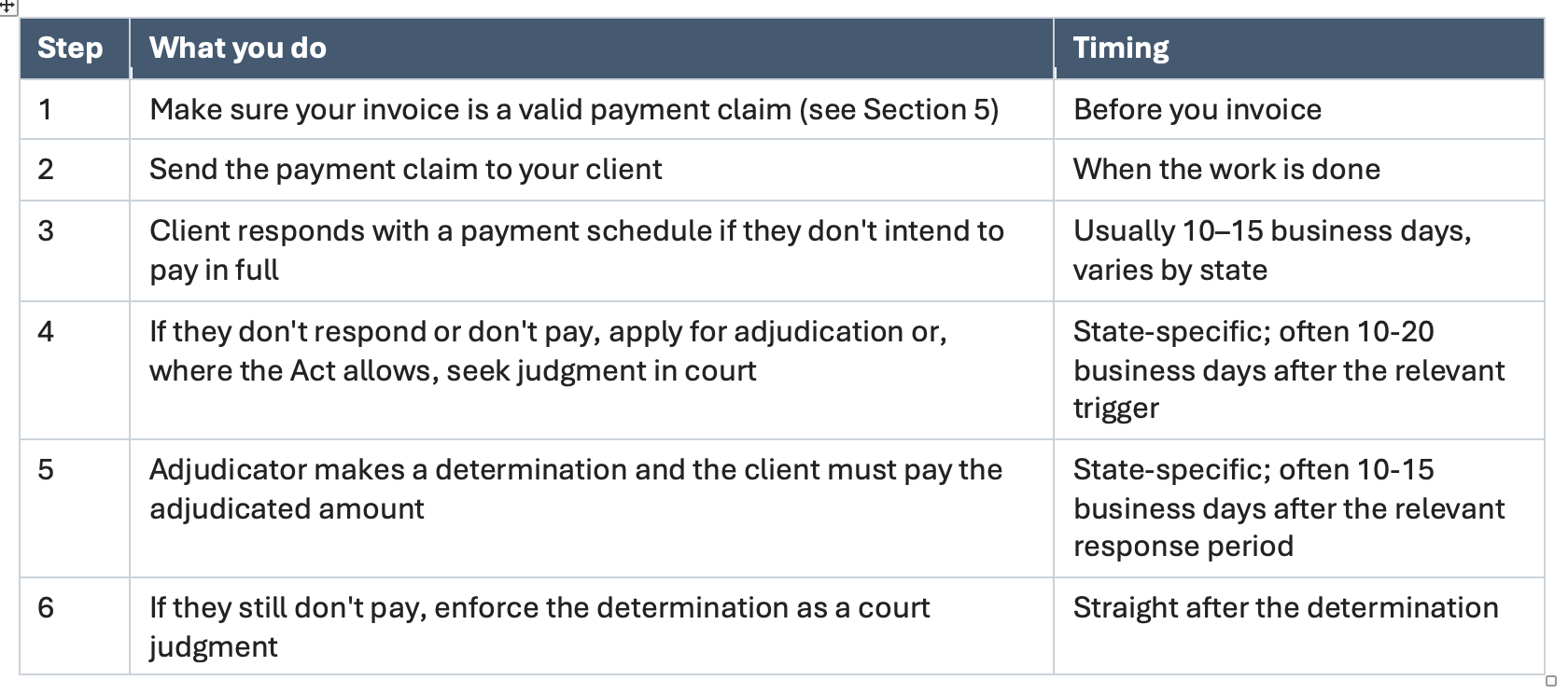
If a client hasn't paid and you want to use SOP, the process runs roughly like this. Timeframes vary by state, so check yours.
Time limits are strict
Miss an SOP deadline, even by a day, and you can lose the right to use the process for that claim. Act quickly, and get advice before a deadline passes if you're unsure.
Deposit caps — what you can charge
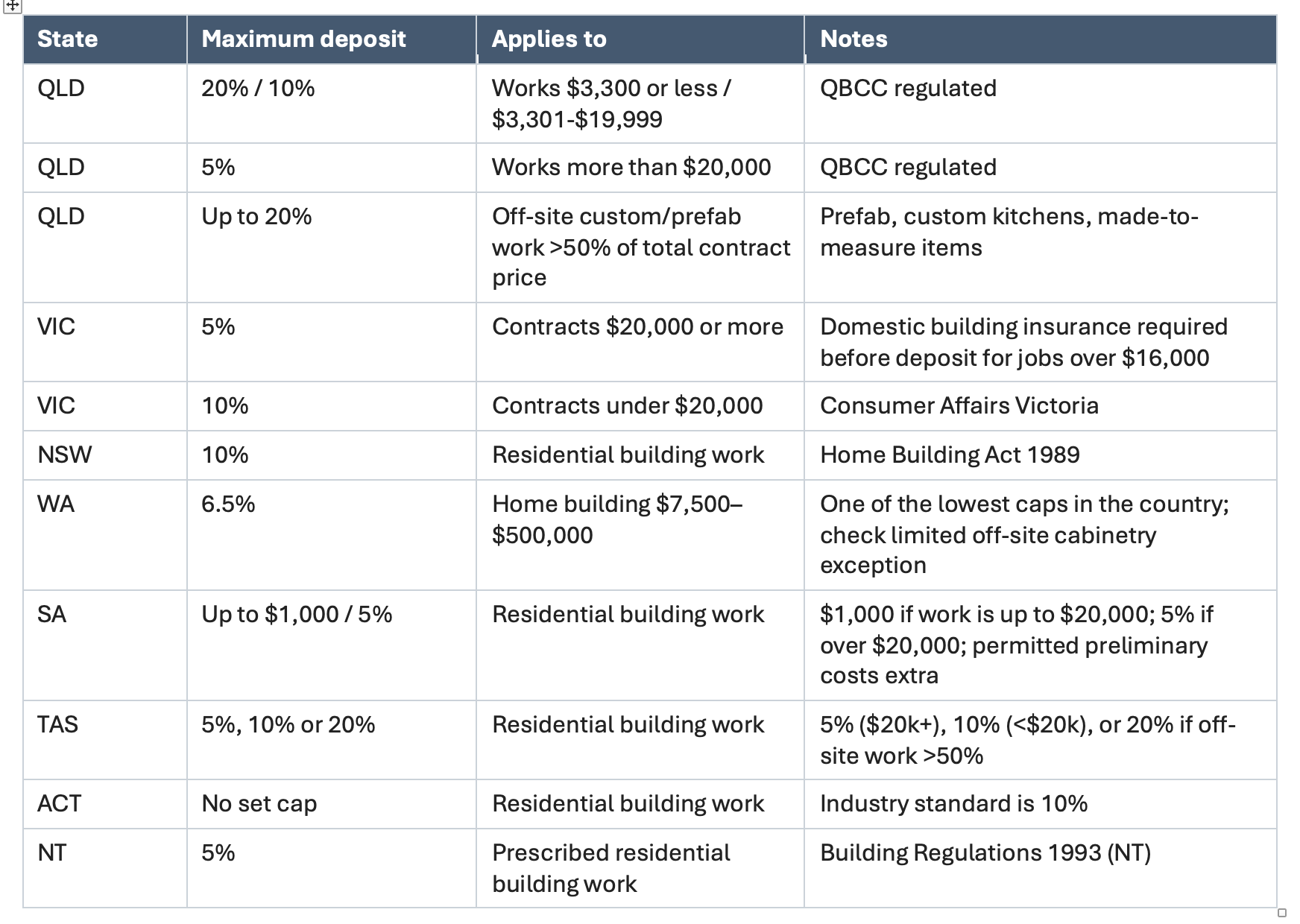
Deposit caps mainly apply to residential building work. They protect home owners from losing large sums if a job doesn't start or a business fails. For commercial work there is generally no cap — the deposit is a matter of negotiation.
These caps apply to residential work
For commercial work there are no prescribed deposit caps, so the deposit is negotiated. Even so, keep it reasonable — 10% is the standard most commercial clients will accept.
Need terms and conditions?
We have a range of terms and conditions at Tradie Contract Co - ready to plug and play. Find them here.
This guide is general information only and is not legal advice. SOP and building laws change regularly and are interpreted differently in each state. Always check the current legislation for the relevant state, and get advice for your situation.
June 2026. © Green APS Pty Limited trading as Tradie Contract Co.