


A day in the life of a Lawnie: nine dramas before knock-off
People think mowing lawns is the easy trade. No heights, no gas, no sparks. Just you, a mower, and a nice quiet arvo in the sun.
Those people have never done a full day of it. Here is how it really goes.
# 6:52am: the first quote that isn't a quote
First job of the day and the customer wants to "just add a few things" while you unload. Trim the hedge. Take away the green waste. Have a look at that dead tree. None of it was in the quote. All of it takes an hour.
You do it anyway, because you're nice, and you spend the drive to the next job doing maths on how much that niceness just cost you. A proper variation clause would have sorted that before you touched the hedge. Lesson one, and it isn't even 7am.
# 8:15am: the surprise in the long grass
You're halfway down the back lawn when the mower finds what the dog left three days ago. It goes everywhere. Your boots, the fence, the freshly cleaned windows, you.
The customer swears they "didn't know he'd been back there." They never do. This is why the dog poo clause now exists in writing. Your customer clears the yard first, or you skip that patch and still get paid, and nobody has to hose down a colorbond fence at 8 in the morning.
# 9:40am: the pebble path incident
Nice job, this one. Tidy front yard, decorative pebble path running right along the front of the house, big picture window over the top.
You know where this is going. So does anyone who has ever run a mower near loose stone. One flick of the blade and you're staring at a cracked pane and a very quiet homeowner. Rocks fly. Glass breaks. It is the single most expensive thing a mower can do in half a second.
The fix isn't luck. It's clearing and disclosing loose stone before you start, pointing the discharge away from the house, and knowing you can decline the dodgy bit. And it's public liability insurance, because no clause on earth pays for a window. The terms do the first part. The insurance does the rest.
# 11:20am: who is actually paying for this?
New client. Lovely older gentleman, wants a regular mow and a bit of garden tidy. You do the job, you send the invoice, and then you learn he's an aged care client and the money comes through a provider you've never spoken to.
Or it's an NDIS participant, and the person who booked you isn't the person who pays, and the funding is "still processing," which is a phrase that has never once meant "you'll be paid this week."
This is the part nobody warns a Lawnie about. The person in front of you isn't always the payer. You need to know how the plan is managed before you start, and you need terms that say who covers the bill when the funding doesn't. That's not admin. That's your cash flow.
# 1:05pm: the turf that dared to die
Remember that turf you laid a month ago? It's brown. The customer is convinced it's your fault. What actually happened is nobody watered it, we've had two weeks of 38 degree days, and something has been chewing the roots.
Plants, turf and seed are living things. They live or die on watering, weather, pests and what happens after you drive off. You can't guarantee a lawn survives someone else's aftercare, and now your terms say so, plainly, without pretending to dodge anyone's consumer rights.
# 2:30pm: the seven day time machine
Same job, different problem. A customer rings about a "defect" from a hedge you shaped six weeks ago. Old terms would have said tough luck, you had seven days. Except plants don't read contracts, and garden problems take weeks to show up.
Sensible terms give people a fair, realistic window to raise a real issue, and still protect you from the bloke who wants a refund in March for a mow in January.
# 4:10pm: the paperwork you keep meaning to do
By now you've done six jobs, dodged a window, hosed off your boots, and chased one invoice twice. The last thing you want at 4pm is to sit down and write terms and conditions from scratch.
So you don't. And that's exactly how tradies end up with no paperwork at all.
# The point of all this
Every one of those dramas is a real risk, and every one of them is cheaper to sort with a sentence than a fight. That's the whole idea behind the Lawnie terms.
We've just relaunched them, and they now cover the messy stuff a real day actually throws at you: dog surprises, flying stones, NDIS and aged care clients, living plants and turf, and the payment cycles that come with funded work. There's even an AI prompt that sets the whole thing up with your business details in minutes, so the 4pm paperwork excuse is gone.
You've got enough going on before knock-off. Your terms shouldn't be one more thing you're winging.
Grab the relaunched Lawnie terms from the shop, and sort the paperwork before the next dog surprise finds you.

Getting paid under Security of Payment Laws (a state by state guide for tradies in Australia)
Getting Paid Under Security of Payment Laws: a state-by-state guide for tradies
Security of Payment (SOP) laws operate in every Australian state and territory. They give people who do construction work, or supply related goods and services, a fast way to recover money they are owed without going to court, through a process called adjudication.
If you do construction work under a contract and you don't get paid, these laws are usually the quickest and cheapest tool you have.
Security of Payment (SOP) laws operate in every Australian state and territory. They give people who do construction work, or supply related goods and services, a fast way to recover money they are owed without going to court, through a process called adjudication.
If you do construction work under a contract and you don't get paid, these laws are usually the quickest and cheapest tool you have.
Does SOP apply to fridgies, sparkies and other tradies?
Usually, yes — for commercial and construction work, and often for residential work too. SOP covers 'construction work' and related goods and services, which takes in installing, maintaining, repairing and testing air conditioning, refrigeration, electrical, plumbing and other building services.
The common myth is that SOP doesn't apply to residential work. The real test is who you contract with. Most SOP Acts only exclude contracts where the other party is a home owner who lives, or intends to live, in the property (an owner-occupier). If you work as a subcontractor to a builder on a house or unit block, your contract is with the builder, not the home owner, so you are generally covered even though the site is residential. Don't assume residential work is out of scope before checking who is on the other side of your contract.
Which law applies in each state?
The state where the work is physically carried out decides which SOP law applies, not where your business is registered or where you signed the contract. The relevant states are:
New South Wales - Building and Construction Industry Security of Payment Act 1999 (NSW)
Victoria - Building and Construction Industry Security of Payment Act 2002 (VIC)
Queensland - Building Industry Fairness (Security of Payment) Act 2017 (QLD)
Western Australia - Building and Construction Industry (Security of Payment) Act 2021 (WA)
South Australia - Building and Construction Industry Security of Payment Act 2009 (SA)
Tasmania - Building and Construction Industry Security of Payment Act 2009 (TAS)
Australian Capital Territory - Building and Construction Industry (Security of Payment) Act 2009 (ACT)
Northern Territory - Construction Contracts (Security of Payments) Act 2004 (NT)
How long clients can take to pay
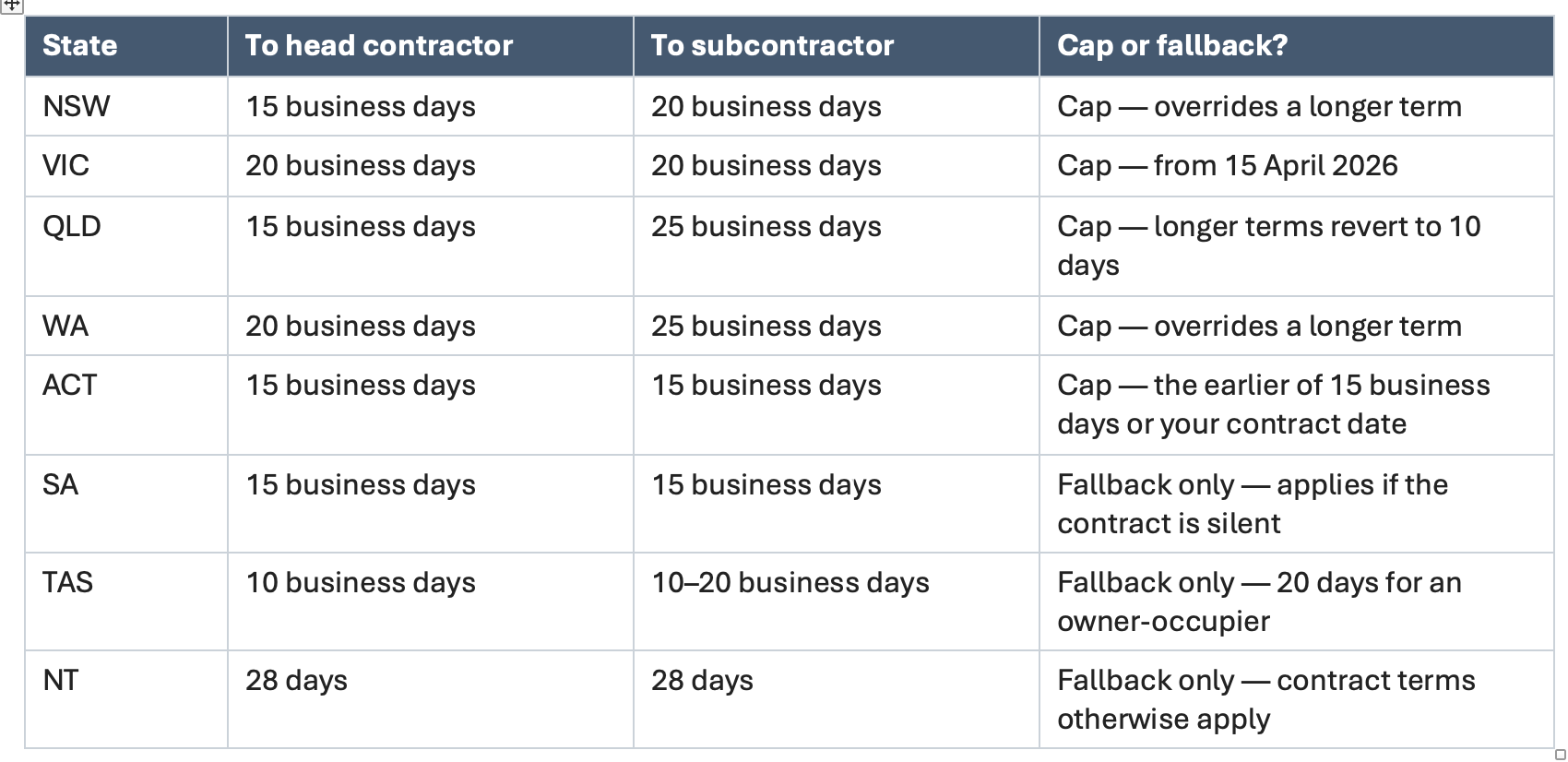
Some states cap how long a client can take to pay you. Others only set a fallback period that applies if your contract doesn't say anything. Knowing the difference matters: a cap overrides a longer term in your contract, a fallback doesn't.
These figures are for commercial construction work and run from the date your payment claim (invoice) is served.
What this means for your terms and conditions
When you set payment terms in your own terms and conditions , keep them within the cap for the states that have a cap.
If your contract says 30 days but the cap is 15 business days, the cap wins.
In SA, TAS and NT there is no cap, so the period you put in your contract is what governs the terms. In this case, set a term that works for you and that complies with any consumer rules for residential jobs.
Victoria (new laws)
Victoria made its biggest SOP changes in more than 20 years. They commenced on 15 April 2026 and apply to existing construction contracts, not only new ones signed after that date.
Here is a summary of the key points:
20 business day cap - clients can't take longer than 20 business days to pay, even if the contract says otherwise.
Reference dates abolished - you no longer have to wait for a monthly 'reference date'. You can claim for any construction work and associated costs under the contract.
Broader claims - contested variations, delay costs and time-related costs can now go to adjudication ( they were excluded before).
Performance security - you can use SOP to have bonds, guarantees and retention money released.
Longer claim window - you now generally have six months after practical completion of the construction work, or the supply of related goods and services, to make a payment claim, up from three months.
Holiday pause - SOP timeframes pause between 22 December and 10 January inclusive each year.
Unfair time bars - a court can declare a notice-based time-bar clause unfair and of no effect.
No new reasons later - if a client leaves a reason for not paying out of their payment schedule, they can't raise it for the first time in adjudication.
If you do commercial or construction work in Victoria, review your payment terms so they don't exceed 20 business days. The changes apply to jobs already underway, not just new ones.
What your invoice / payment claim must include
To use the SOP process, your invoice has to qualify as a valid payment claim under the relevant state law. This means that every invoice in ever state must include:
• Your business name and ABN
• Your client's name and address
• A description of the work or goods and services supplied
• The amount claimed, and how GST is treated
• The date the invoice was issued
• Your bank account details for payment
The SOP statement
Several states require your invoice to carry a specific line identifying it as a payment claim under their Act. Queensland, Victoria and the NT do not require that statement, so the wording is optional there.
Here is a state by state breakdown of what you need to include:
New South Wales - This is a payment claim made under the Building and Construction Industry Security of Payment Act 1999 (NSW)
Queensland (optional) - No statement required. The invoice just needs to identify the work and request payment.
Western Australia - This is a payment claim made under the Building and Construction Industry (Security of Payment) Act 2021 (WA)
South Australia - This is a payment claim made under the Building and Construction Industry Security of Payment Act 2009 (SA)
Tasmania - This is a payment claim made under the Building and Construction Industry Security of Payment Act 2009 (TAS)
Australian Capital Territory - This is a payment claim made under the Building and Construction Industry (Security of Payment) Act 2009 (ACT)
Victoria - No statement required.
Northern Territory - No statement required. Check your contract terms.
Top tip - set it and forget it
Add the relevant SOP statement to your invoice template in Tradify, Xero, ServiceM8 or whatever you use, so it goes on every invoice automatically. If you work across states, set up state-specific templates based on the job address, or ask your software provider how to do it.
Retention money — state by state
Some commercial contracts hold back a percentage of your payment until the end of the defects liability period. How that retained money must be handled varies. As a state by state summary note that:
New South Wales - requires retention be quarantined above a threshold. Retention on larger projects must be held in a trust account. Smaller jobs aren't caught. You should always be aware of the current threshold.
Victoria - the new laws don't require quarantining as at June 2026. Watch for further reform.
Queensland - project trust accounts apply to larger projects.
Western Australia - retention trust account requirements apply.
South Australia - no quarantine requirement
Tasmania - no quarantine requirement
Australian Capital Territory - no quarantine requirement.
Northern Territory - Security of payment provisions apply; no general retention trust.
Using SOP to get paid — the basic process
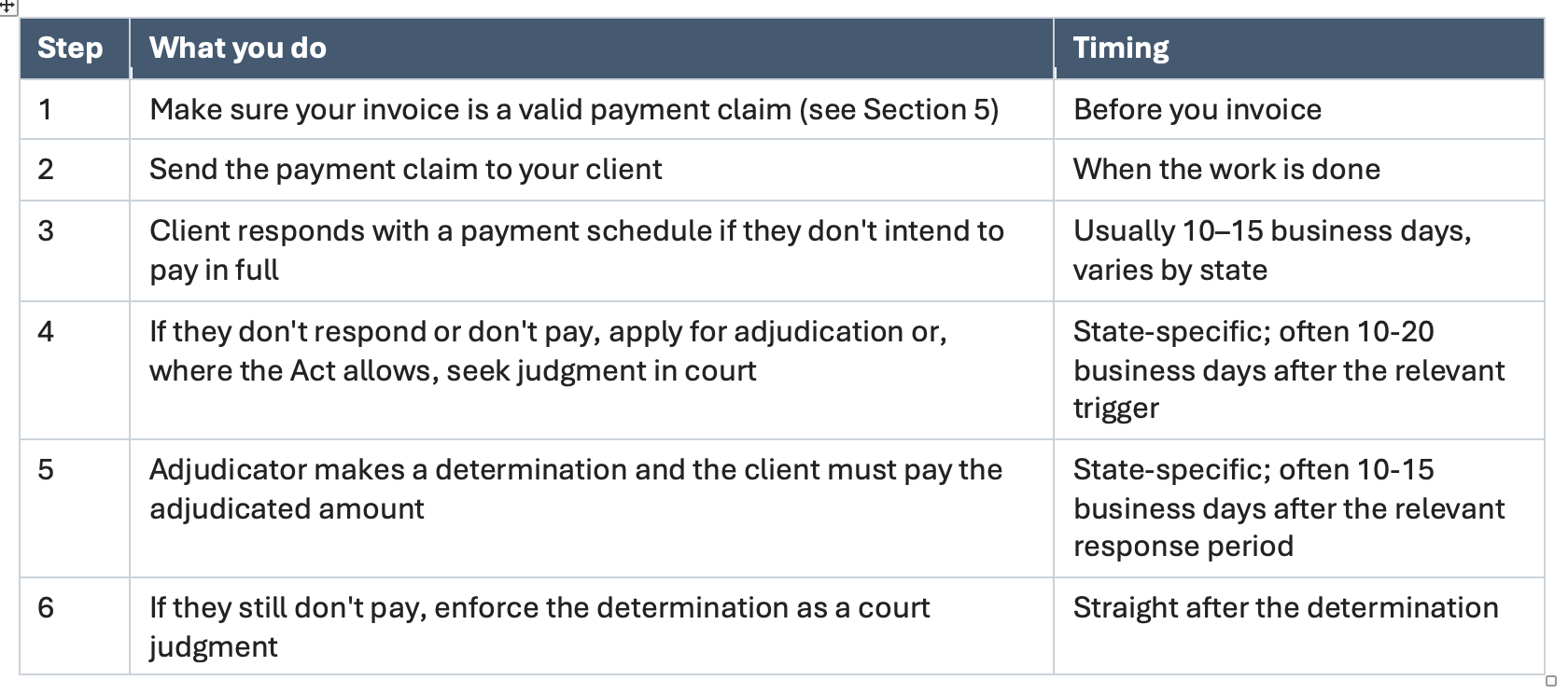
If a client hasn't paid and you want to use SOP, the process runs roughly like this. Timeframes vary by state, so check yours.
Time limits are strict
Miss an SOP deadline, even by a day, and you can lose the right to use the process for that claim. Act quickly, and get advice before a deadline passes if you're unsure.
Deposit caps — what you can charge
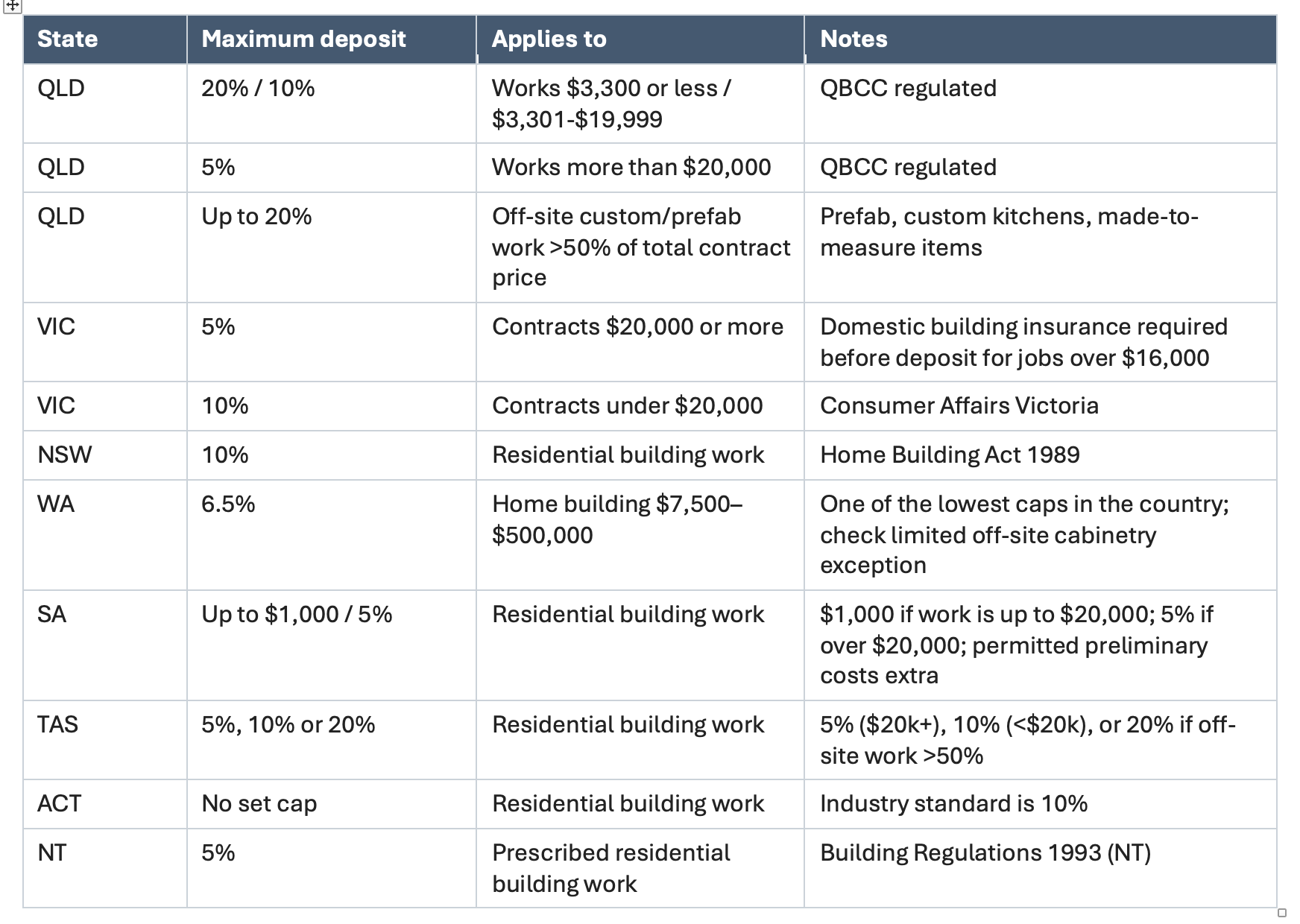
Deposit caps mainly apply to residential building work. They protect home owners from losing large sums if a job doesn't start or a business fails. For commercial work there is generally no cap — the deposit is a matter of negotiation.
These caps apply to residential work
For commercial work there are no prescribed deposit caps, so the deposit is negotiated. Even so, keep it reasonable — 10% is the standard most commercial clients will accept.
Need terms and conditions?
We have a range of terms and conditions at Tradie Contract Co - ready to plug and play. Find them here.
This guide is general information only and is not legal advice. SOP and building laws change regularly and are interpreted differently in each state. Always check the current legislation for the relevant state, and get advice for your situation.
June 2026. © Green APS Pty Limited trading as Tradie Contract Co.

"Thinking of using AI to generate your contracts? Read this first"
AI tools are everywhere right now.
And sure — they can spit out a contract in seconds.
But when it comes to your tradie business, “quick and easy” isn’t always the same as “actually protects you”.
The problem with AI-generated contracts
AI doesn’t know your business.
It doesn’t know:
- how you quote
- how you deal with variations
- how your jobs actually run on site
And it definitely doesn’t understand how Aussie laws apply to what you do day-to-day.
What you get is usually:
something that looks like a contract
but doesn’t quite fit how your business works
Where things go wrong
Most issues don’t show up when everything is going smoothly.
They show up when:
- a client pushes back on price
- a job runs over
- someone says “that wasn’t included”
- or a payment doesn’t come through
That’s when your contract actually matters.
And if it’s vague, generic or doesn’t line up with your real process:
it won’t help much when you need it.
AI doesn’t understand Aussie requirements
In Australia, you’re dealing with things like:
- Australian Consumer Law
- unfair contract terms
- privacy rules
- payment and refund expectations
AI-generated documents often:
- miss key requirements
- use overseas wording
- or include clauses that don’t hold up here
It’s not just about having a contract — it’s about having the right one
A good contract should:
- match how you actually run your jobs
- clearly set out scope and pricing
- cover variations and extras
- make payment expectations obvious
- handle disputes properly
So what’s different about Tradie Contract Co?
Tradie Contract Co is built by a lawyer and a tradie.
That means:
it’s legally sound
but also practical and usable on real jobs
Everything is:
- written in plain English
- designed for Aussie tradies
- structured to actually work with how you quote, invoice and get paid
Built for real jobs, not theory
These documents aren’t pulled from overseas templates or generated on the fly.
They’re built from:
- real legal experience
- real job scenarios
- and real issues tradies run into every day
The bottom line
AI can be a useful tool.
But when it comes to your contracts — the thing that protects your work, your time and your money — it’s not where you want to cut corners.
Because when something goes wrong, that’s when you find out if your paperwork actually works.
Want contracts that actually do their job?
That’s exactly why we built Tradie Contract Co.
Simple, legally drafted documents you can plug straight into your business — without the guesswork.
AI tools are everywhere right now.
And look, they're impressive. You can punch in a few prompts and get something that looks like a contract in about 30 seconds.
But here's the thing…
When it comes to your tradie business, "quick and easy" doesn't always mean "actually protects you".
We get why people use it
Most tradies aren't sitting around thinking:
"I'd love to spend my afternoon drafting legal documents"
You've got jobs to run, quotes to send, and a million other things going on.
So when something promises "just copy this and you're covered"… it sounds like a win.
The problem is, that's not really how this stuff works in the real world.
AI doesn't actually understand how your jobs run
It can generate words, but it doesn't know:
how you quote your work
how you deal with variations on site
how often things change mid-job
or how clients actually behave when things get tricky
It's not thinking about "what happens when the customer says that wasn't included?"
It's just generating a document based on patterns, so what you end up with is usually something that looks right but doesn't quite fit how your business actually operates.
The real problems show up later
When everything is going smoothly, almost any contract looks fine.
You don't notice the gaps when:
the client is easy
the job runs to plan
payment comes through on time
But problems don't show up on good jobs. They show up when:
a client pushes back on price
someone asks for "just one more thing"
the job blows out
or payment doesn't land when it should
That's when your contract actually gets tested, and if it's vague, generic, or doesn't line up with how you actually work, it won't do much when you need it.
Then there's the Aussie legal side of things
This is the bit most people don't think about. In Australia, you're dealing with:
Australian Consumer Law
unfair contract terms
privacy obligations
refund and warranty expectations
A lot of AI-generated documents:
pull wording from overseas
miss key requirements
or include clauses that don't really stack up here
So you might think "sweet, I've got a contract sorted", but in reality it's not properly aligned with Aussie law, and that can come back to bite you.
It's not just about having a contract
This is the big one. Having a contract isn't the goal, having the right contract for how you run your business is what actually matters.
A good contract should:
match how you quote and invoice
clearly set out scope and pricing
deal with variations properly
make payment expectations obvious
and give you something to fall back on if things go sideways
That's what protects you.
So where does Tradie Contract Co fit into this?
Tradie Contract Co was built pretty simply: one of us is a lawyer and one of us is a tradie.
Between us, we've seen both sides:
how things are supposed to work legally
and how they actually play out on site
So instead of expensive, overcomplicated legal docs, or generic templates that don't fit, we built something in the middle.
What you're actually getting
Everything we create is:
legally drafted for Australian use
written in plain English
designed for real tradie jobs
and structured so you can actually use it day-to-day
Not something you read once and forget, but something you send with quotes, use on every job and rely on when things don't go to plan.
Built from real situations, not theory
These aren't pulled from some overseas template or generated on the fly.
They're based on:
real disputes
real client issues
real payment problems
and real "that wasn't included" conversations
So instead of trying to make a generic contract fit your business… you're starting with something that already makes sense.
The bottom line
AI is a tool. And for a lot of things, it's useful.
But when it comes to your contracts, the thing that protects your work, your time and your money, it's not where you want to cut corners.
Because when something goes wrong, that's when you find out whether your paperwork actually does its job.
If you want to get it sorted properly
That's exactly why we built Tradie Contract Co.
Simple, legally drafted documents you can plug straight into your business, without the guesswork.

Direct Debit for tradies: the set and forget cashflow move
Direct debit for tradies: the set and forget cashflow move, without the headaches
If you’re sick of chasing invoices, waiting on bank transfers and doing the awkward, “just following up” texts and emails, direct debit can be a game changer for tradies who do regular work, such as lawnies or landscapers.
If you’re sick of chasing invoices, waiting on bank transfers, and doing the awkward “just following up…” text and emails, direct debit can be a proper game-changer for tradies and small Aussie service businesses.
Done right, it smooths out your cash flow, cuts late payments, and saves you (or your partner / office legend) a stack of admin time. Done wrong, it can land you in disputes, chargebacks, complaints, and that “this feels dodgy” reputation you never asked for.
That’s why you need a clear, compliant Direct Debit Service Agreement that sets the rules for how and when you debit a customer’s bank account that is in plain English and backs you up when something goes sideways.
In this guide, we’ll walk you through what a Direct Debit Service Agreement is, the key clauses to include, how it interacts with Australian laws (including the Australian Consumer Law and privacy rules), and a step-by-step process to roll it out with confidence
What is a direct debit service agreement?
Your tradie needs the following two things to allow a direct debit to take place:
A direct debit request form (DDR) - the form usually supplied by your bank to give permission to debit the bank acount. These are often supplied by your bank to give your customers; and
A Direct Debit Service Agreement - a contract between your business and your customer explaining how the arrangement will work. This sets out things like when you will debit, how often, notice periods and failed payment fees etc.
If you’re using a payment platform, they might give you a template. But, that doesn’t necessarily mean you’re covered.
You’re still responsible for making sure your terms are accurate for your business model, fair and transparent, and aligned with Australian consumer and privacy rules.
Why offer direct debit?
Direct debit is popular for ongoing maintenance plans, subscriptions, and instalments because it helps with predictable revenue and reduces the need for you to chase payments. It can also lower transaction costs compared to some cards.
The flip side is legal and operational risk. If your terms are unclear, you can face disputes, complaints or accusations of unfair contract terms. A confusing cancellation process or hidden fee can damage trust and trigger compliance issues.
Getting your Direct Debit Service Agreement right manages those risks and sets expectations upfront. It also makes your life easier when handling billing questions or schedule changes.
What laws and rules apply to Direct Debit Agreements for Tradies in Australia?
There are a number of rules that regulate direct debit arrangements. You don’t need to be a lawyer to comply, but you do need to understand the basics and bake them into your agreement and processes.
Provider obligations
If you’re debiting Australian bank accounts via the direct entry system, there are scheme/provider expectations (usually flowing through your bank/payment provider). Common requirements include providing the DDR and Service Agreement upfront, giving reasonable notice before changes to debit amount/date, and having a clear dispute and refund process.
Your agreement should reflect these expectations in plain English and match what your provider requires.
Australian Consumer Law and Unfair contract law
If your direct debit terms are used with consumers or small businesses (standard form contracts), unfair contract terms can become a real issue. Red flags include letting you change price without notice, making cancellation painful, charging punitive fees, or hiding important conditions in fine print.
You need to make sure your Direct Debit Service Agreement covers off these items.
Privacy and data security
Direct debit means handling bank details and personal information. You should have a Privacy Policy that matches your practices, restrict internal access to a need-to-know basis, and store data securely.
You can find our privacy policy here.
Fair notice and transparency
Notice periods are critical to make sure there is advance notice for changes to pricing or direct debit dates. Even if your provider doesn’t mandate a specific number, choose a reasonable notice period and follow it consistently.
Your tradie-friendly checklist of things to include in your Direct Debit Service Agreement
You should include clauses relating to:
Authorisation and scope - make sure the agreement clearly allows you to debit the nominated account and specify whether the debits are fixed amounts or variable and if variable, explain how the amount is calculated;
The debt schedule - the frequency of debits needs to be set out, as does what happens when the day falls on a weekend or public holiday and make sure the number of payments is listed.
Notice of changes - give advance notice of change of direct debit dates or amounts and explain how you hgive the notice, eg by email or text etc.
Failed payments - disclose what happens when a payment is dishonoured or fails, is there a fee and will it be re-tried?
Disputes, errors and refunds - provide a simple process for reporting unauthorised or incorrect debits and offer a clear response timeframe in such cases;
Cancellation - how can a customer cancel the request and how much notice is required?
Privacy and data security - refer to your privacy policy and explain how the bank handles the details;
Contact details and complaints pathway - include a dedicated email and phone number for complaints;
Link to your terms and conditions - make sure you link to your Terms of Business.
Key takeaways
A Direct Debit Service Agreement sets the rules for debiting a customer’s bank account and works alongside the DDR (authorisation).
Build your terms around transparency: amounts (or how calculated), debit timing, notice of changes, dishonours, disputes/refunds and cancellation.
Align with Australian rules, including unfair contract terms under the ACL, scheme expectations, and privacy obligations supported by a strong Privacy Policy and Data Breach Response Plan.
Integrate payments language with your wider contracts, such as Terms of Trade and Website Terms, so customers get a consistent experience.
Provider templates can be a starting point, but a tailored agreement will protect your business and make billing smoother.
Want a tradie ready direct debit service agreement template?
That’s exactly why we’re drafting the Tradie Contract Co Direct Debit Service Agreement Template.
It’s built for Aussie trades and service businesses who want set-and-forget payments without running foul of consumer law, privacy expectations, or messy disputes.
When it drops, you’ll be able to plug it into your onboarding process, align it with your Terms of Trade and invoices, set clear rules around notice, dishonours, and cancellations, and stop payment admin from chewing up your week.